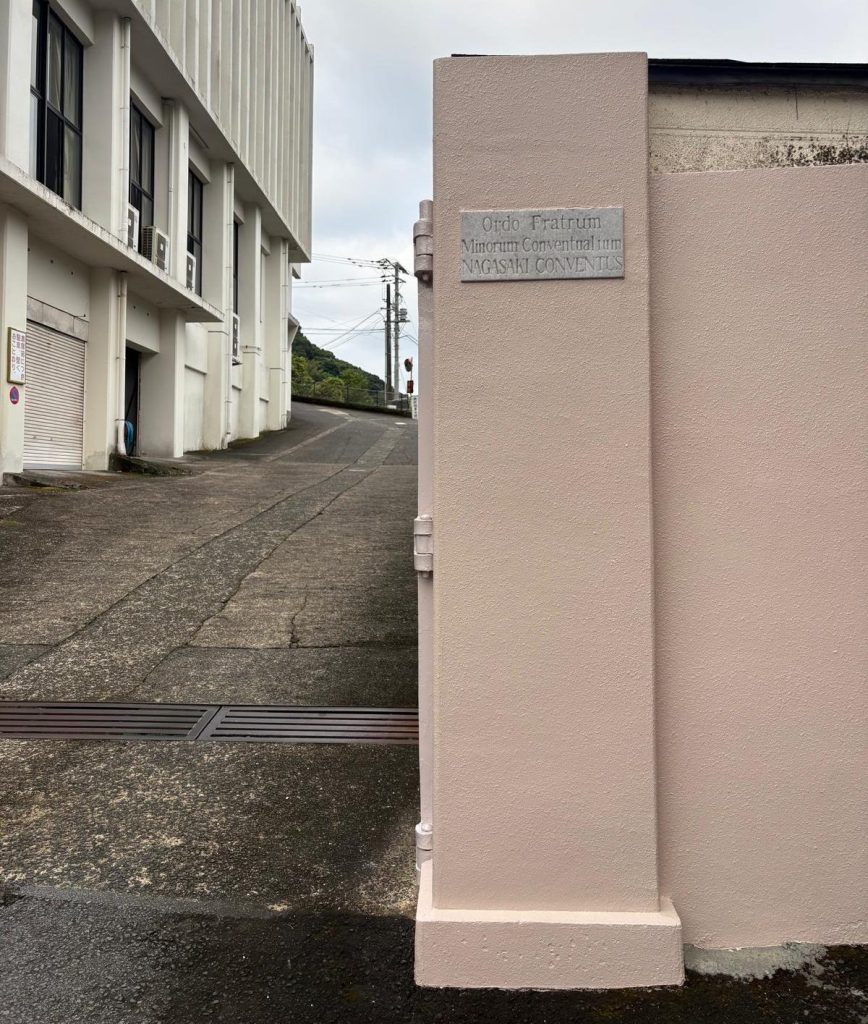
Seibo no Kishi (Knights of the Holy Mother) is the name given to the friary of the Franciscan Friars of the Order of Friars Minor Conventual (‘Conventual Friars’ for short). Founded by Fr. Kolbe on May 16th, 1931, the monastery is located on another Nagasaki hillside- in an area called ‘Hongochi’.
A small word of advice for those planning to visit using public transport. Getting near the monastery complex is easy. Simply get off the tram at the terminus station- the wonderfully-named ‘Hotarujaya’ (蛍茶屋) which translates as Firefly Teahouse (where all adventures begin!). But from there pretend you are a car and stick to the paved road. Do not rely on Google Maps on this last part- and do not walk into the Buddhist cemetery built on the lowlands surrounding the monastery. Ideally and unlike me, you will then be able to enter through the main entrance!
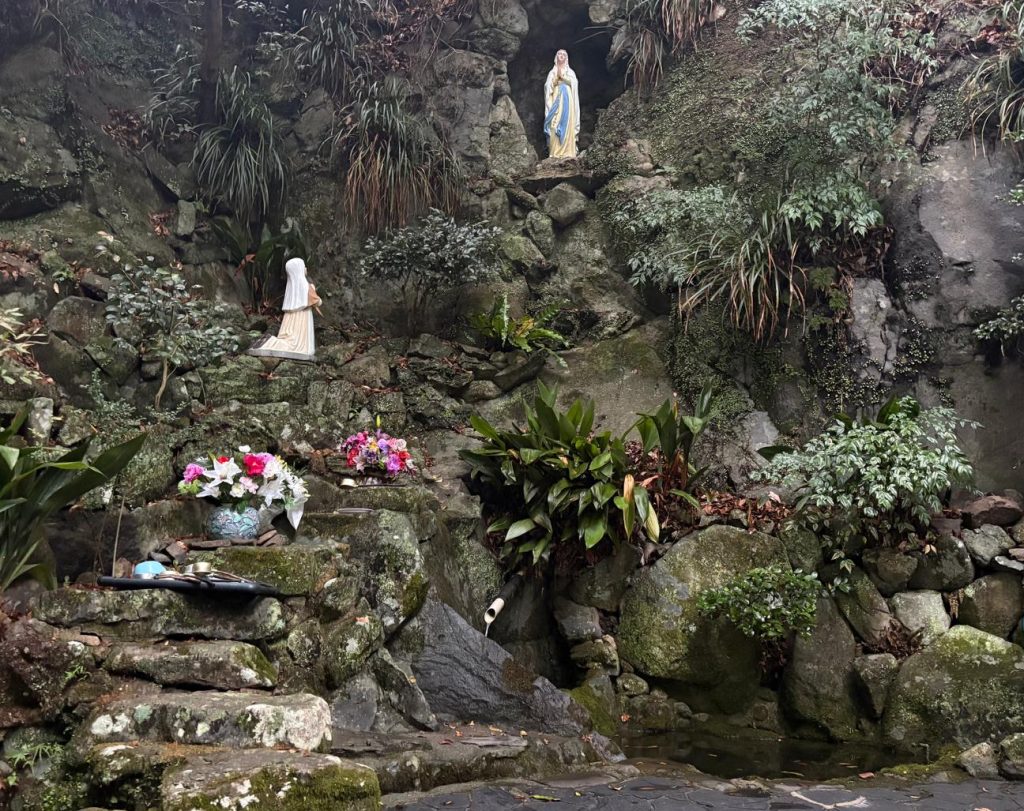
But just to be clear, Seibo no Kishi is a working friary so some buildings such as the school blocks and the Formation House are not open to the public. But there’s plenty to see besides. I made straight for the Lourdes Grotto (which was well signed with the Japanese rendition of Lourdes (ルルド) and about a 5-minute steep walk from the entrance. Along the way, which on a rainy day can be a bit slippery, you walk the Rosary Slope with five plagues each showing 3 x mysteries of the Rosary which date back to 1971 when St. Kolbe was beatified.
The Early Years of Seibo no Kishi
The seeds for the monastery in Nagasaki were sown in 1927- on the outskirts of Warsaw, Poland where Fr. Kolbe built the Niepokolanow Friary. In 1930, along with four brothers (one of which was a certain Br. Zeno) , they left Poland for the evangelisation of Asia. On April 24th they landed in Dejima, Nagasaki and within one month of landing the first issue of the ‘Seibo no Kishi’ magazine was published. The magazine is still in circulation today and still being published from the monastery!
The current site was purchased in 1931 at ‘Hongochi’. It had been used as a cemetery for undesirables and was believed to be haunted. But Fr. Kolbe viewed the hillside location as being suited for a Grotto to Our Lady of Lourdes. Despite being ill with tuberculosis, Fr. Kolbe oversaw the building of a chapel friary and a minor seminary, attracting many of the descendants of Japan’s early Christian communities. In May 1936, Fr. Kolbe returned to Poland for a meeting and was elected guardian of the original friary outside Krakow. Having no say in the matter, his six years in Japan were ended abruptly.
The next year Japan began its war with China but when the Nazis invaded Poland on the 1st of September, 1939, Br. Zeno and the remaining Polish Franciscans became instant ‘enemy aliens’. They were placed under house arrest by the Japanese military police (Kenpeitai) with the exception of Br. Zeno who was free to come and go to get provisions. Br. Zeno lived by the instructions received from Fr. Kolbe, which possibly helped his cause.
“We have come to Japan to teach a gospel of love, not to condemn the Japanese people”
With US forces landing in Okinawa in April of 1945, fears of a larger land invasion meant that aside from Br. Zeno, all the other friars were arrested and taken to a location near Mt. Aso in Kumamoto to be killed as possible enemy collaborators. Instead, on August 9th an atomic bomb was dropped on Nagasaki. Despite being only three miles from the epicenter blast, the friary survived as did Br. Zeno , due to its unusual cliffside location chosen for the site of a Grotto of Our Lady of Lourdes.
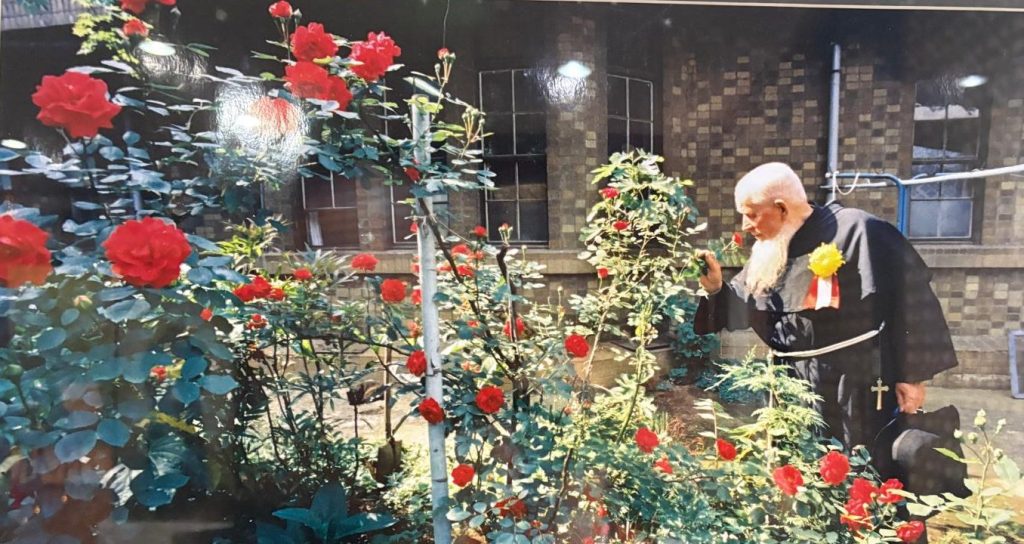
The war ended on August 15th and the friars moved back home- soon to be joined by a multitude of war orphans from all over Japan. Meanwhile Br. Zeno in particular, uses whatever means possible to travel Japan to assist the poor and afflicted. When he died in 1982, having met the Polish Pope the previous year, he was well known in Japan as the bearded friar.
Leave a Reply